The lady’s journey to Paradise
The Blazing WorldThe lady’s journey to Paradise is both a passage through the Blazing-World and an introduction to its political and social order. After the Lady is rescued from a frozen sea, Bear-men, Fox-men, Bird-men, Satyrs, and other inhabitants escort her across islands and rivers toward the Emperor’s residence. Their repeated hospitality makes a route through strikingly different peoples appear safe and navigable; at its destination, the glittering city of Paradise reveals the single language and sovereign authority that bind the world together. The journey’s peaceful welcome also forms a contrast with the imperial violence the Empress later directs from this world toward her own country’s opponents.
From the Ice to a Chain of Hosts
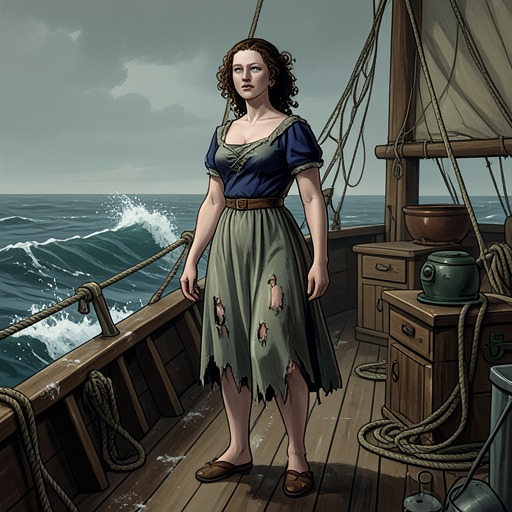
The journey begins after the Lady has survived a passage through joined worlds and found herself among the dead men of her boat. As the ice-bound vessel enters a thaw, the bodies begin to corrupt. Unable to throw them overboard, she moves from the cabin onto the deck to escape the smell. The boat passes between expanses of ice until she sees snow-covered land and upright, bear-shaped creatures approaching across the ice. They inspect the boat, carry her out, and sink it together with the dead men, severing her from the means by which she arrived.
The Lady initially expects the Bear-men to kill her. Instead, they lift her from the slippery ice and carry her to a city of underground caves. Its inhabitants, males and females, young and old, crowd around to stare in wonder. They leave the Lady in a spacious cave under the care of women, who treat her kindly and give her their own food. Recognizing that the climate and diet do not suit her constitution, her hosts arrange for her to be taken to a warmer island rather than expecting her to adapt to them.
On that island, upright Fox-men receive the Bear-men with civility and admire the Lady’s beauty. After conferring, the two peoples agree to present her to the Emperor of the Blazing-World. They take her across the island to a broad, clear river and transport her by boat; Bear-men and Fox-men accompany her. Each transfer advances her toward the imperial center through the courtesy of the inhabitants she meets, rather than through a single guide or a direct route.
Peoples, Rivers, and Passage
Across the next river the party reaches an island inhabited by upright Bird-men, whose heads, beaks, and feathers resemble wild geese. The Bear-men and Fox-men explain their purpose, and some Bird-men join the escort. They accompany the Lady across the island to another great river, where larger boats, compared to birds’ nests, are waiting. Beyond it lies an island of pleasant, mild climate inhabited by Satyrs, who welcome the travelers and confer with them. Some of the Satyrs then join the party for the next leg of the journey.
After another river crossing, the Lady’s escorts enter a spacious kingdom whose people have grass-green complexions. They welcome the travelers and provide for the remainder of their voyage. Rivers have carried the party up to this point; now the open sea cannot be avoided. The inhabitants prepare ships for the passage to the island where the Emperor resides. The sequence makes the journey’s geography a social itinerary: every new territory brings another people into the escort, and each meeting supplies the cooperation needed to continue.
The Lady’s first response to this succession of unfamiliar places is fear and doubt about whether her adventure will end in safety or destruction. But her generous spirit and ready wit help her take courage. She tries to learn the languages of her attendants and, once she can grasp their meaning through some words and signs, ceases to regard them as a threat. She comes to feel safe and happy among them. The narrator makes this change a lesson in the settling power of familiarity: novelty first unsettles the mind, while acquaintance brings peace and tranquillity.
Navigating the Sea and Finding the Entrance
The sea crossing displays the travelers’ expertise in navigation. Although they do not use the loadstone, needle, or pendulous watches, their observations and practice let them judge sea depth and detect sandbanks, rocks, and other obstructions. They consider augury more necessary and beneficial than compasses, charts, or watches. Their ships also carry engines that draw in large quantities of air and force it out as wind. In a calm the engines are placed behind a vessel to propel it; in a storm they go in front, where their artificial wind batters the waves and opens a way through them.
The fleet has a further means of resisting bad weather: ships can be joined closely, like cells in a honeycomb, and fastened together so that wind and waves cannot separate them. The Emperor’s ships are made of gold, light enough to sail because they are skillfully constructed without the thickness of wooden vessels. They are soldered together to prevent leaks and need neither pitch nor tar, pumps nor guns; the account says their only enemies are the winds. Merchant ships are made of leather, lighter but less secure, and are pitched against the water. These details make the voyage not simply a succession of scenic crossings but a demonstration of the Blazing-World’s practical ingenuity.
After passing rich islands and kingdoms, the party approaches Paradise, the Emperor’s seat. At first the Lady sees only high rocks, apparently touching the sky and seeming to form one continuous barrier. Nearer at hand she makes out a cleft in the rock and a stream of boats emerging from it, small in the distance like ants marching one after another. The boats fit together like the cells of a honeycomb. When the travelers’ ships meet them, their crews exchange courteous greetings in the single language spoken throughout the world.
The cleft leads to the only entrance into the imperial territory. The route winds through the rocks like a labyrinth and admits no large vessel: only small boats, each carrying no more than three passengers, can pass. The narrow passage is both a physical threshold and a defense, making the journey’s final approach dependent on being ferried through the one controlled way in. Beyond it, rivers divide the pleasant, mild region into many islands, described as healthful, rich, and fruitful and protected from foreign invasion by the difficult entrance.
Paradise and the Order of the World
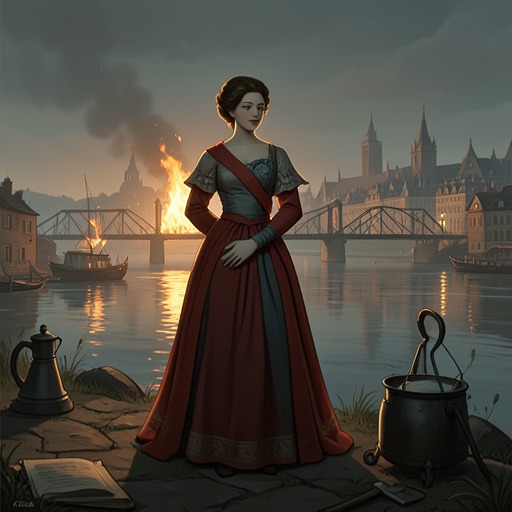
The Lady passes cities built from marble, alabaster, agate, amber, coral, and other precious materials before reaching Paradise. The imperial city is itself built of gold. Rivers run between its streets, so that it appears divided into islands, while numerous bridges connect its parts. Its architecture is broad rather than towering: its buildings, unlike the narrator’s disparaged modern houses, do not exceed two stories above their underground rooms. The journey ends not in a conventional walled capital but in a landscape where waterways, bridges, and precious materials give the city its distinct form.
The arrival discloses a political order as striking as the architecture. The inhabitants who meet the fleet have varied complexions, yet all speak one language; all submit to one Emperor. The account links this shared obedience to lasting peace and happiness, claiming that the world knows neither foreign wars nor domestic insurrections. The welcoming route therefore culminates in more than the Lady’s safe arrival: it presents a society whose internal unity is treated as the explanation for its peace.
Later descriptions extend the journey’s first encounters into an account of differentiated social roles. The Empress encourages the inhabitants to pursue professions suited to their kinds: Bear-men serve as experimental philosophers, Bird-men as astronomers, Fox-men as politicians, Satyrs as physicians, and other peoples take up natural philosophy, chemistry, mathematics, rhetoric, logic, and architecture. Their schools and learned societies turn bodily and social difference into a system of specialized work. The journey has already made that diversity visible through successive meetings; the later account shows how the imperial state organizes it.
From Safe Conduct to Imperial Power
The hospitality that carries the Lady to Paradise stands in revealing contrast with the Empress’s later expedition to her native country. On reaching that world, the Empress sends a letter to its commanders offering assistance against the enemies attacking them. She describes her intervention as loyalty to her birthplace and says that she will make it powerful, without seeking a bargain or placing her own interest above its safety. She promises to destroy its enemies at sea and assist against any land forces as well.
That pledge soon becomes a program of submission. After the enemy fleets have been destroyed, the Empress tells the King of Esfi that she will burn or sink ships that refuse to pay him tribute. Neighboring maritime nations reject the demand, so she orders their ships destroyed and eventually forces them to accept the tribute conditions. When some nations later unite against the King and refuse renewed subjection, she again destroys their naval strength and threatens to burn towns and cities. She distinguishes between those dependent on foreign commerce and those able to live without it, but the latter too face coercion when they refuse to submit.
Seen against that later campaign, the journey to Paradise establishes a pointed contrast between welcome within the Blazing-World and forced compliance beyond it. The Lady crosses the world because its peoples receive and escort her; the Empress later insists that other peoples submit to the ruler she supports. The route’s sequence of courteous encounters offers a vision of difference made cooperative under common political authority, while the expedition shows the coercion that can accompany the extension of that authority abroad. The journey thus introduces the world’s peace and prosperity without leaving its imperial structure unexamined.